Wednesday, March 27, 2013

Preservation or Parking Lot?


I was talking with a Plymouth resident this afternoon when the subject of the 1820 Courthouse came up. For those who don’t know, the Courthouse is a local landmark purchased several years ago by the Plymouth Town Meeting in order to carry out renovations and restore use to Plymouth citizens. For the town’s 400 year anniversary, approaching in 2020, some town planners have recommended that Plymouth use the Courthouse as a focal point and welcoming center for the large influx of tourists that are expected to visit America’s Hometown.

So anyways, the Plymouth resident. The conversation veered back and forth; we talked about the types of shops that make up downtown Plymouth’s main street (mostly bars and antique shops), we talked about local politics (surprisingly factional) and we talked about the town’s upcoming quadri-centennial. The Courthouse was mentioned, as was its potential role in the celebrations. It was then that my companion made a statement that made my blood run cold.

“It’s an eyesore,” he told me, pointing in the direction of the structure. “I think we should knock it down and turn it into a parking lot.”

Whoa. Were we talking about the same building? Was there another courthouse that I didn’t know about? Maybe the structure that he was referring to was a decrepit old slum, or a crack den. Certainly we couldn’t be talking about the elegant, centuries old building that marked the northern entrance into Plymouth’s historic district.

But we were. Incredulous, I listened as he laid out his arguments for the parking lot idea; the increasingly political atmosphere of the redevelopment project, the mounting costs, the lengthening delays. It was reasoning by a not-unreasonable individual, who’d decided that the cost and sacrifice to preserve this particular cultural icon simply wasn’t worth the trouble.

And rather than try to convince him, I walked away. Just like that. Part of it was my unwillingness to catch such a political hot potato, part of it was simply surprise at the direction the conversation had veered. I didn’t know the arguments, didn’t know the parties involved, didn’t have the statistics, couldn’t form the responses. Couldn’t make my case.

So I went home, and I got on my computer. And now I’m going to try again.

  1. THE EYESORE. I know that beauty is in the eye of the beholder, but I can’t help but wonder whether anyone actually thinks that this,


is more of an eyesore than this.
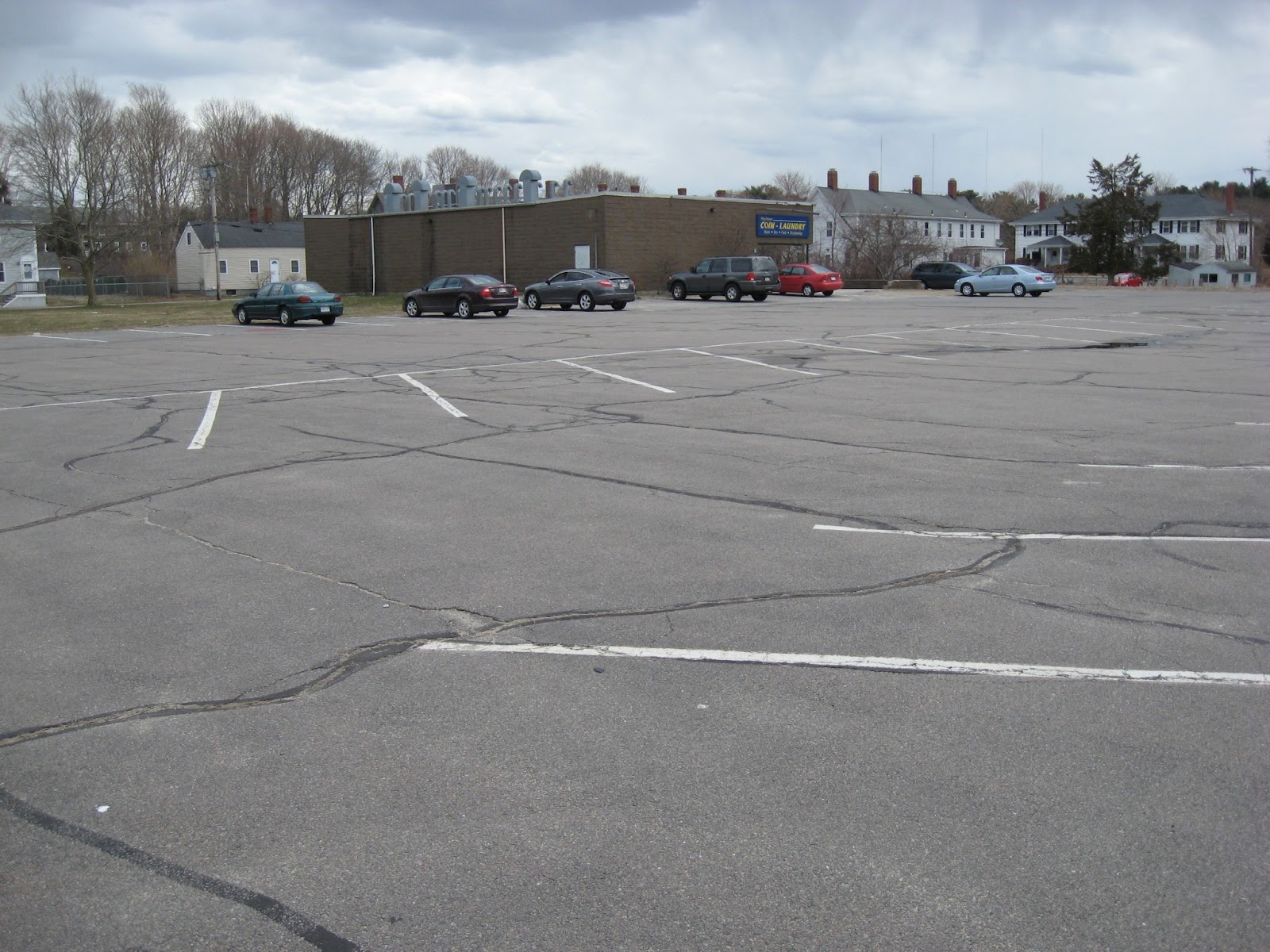


Some people don’t like certain types of buildings, or certain types of architecture. I understand this. But whether early 19th century construction is your cup of tea or not, I’m fairly certain that more visitors to Plymouth will stop to appreciate the Courthouse as it currently stands than if it was razed and paved. People don’t often spend their vacations taking pictures of parking lots, after all.

  1. THE POLITICS. The 1820 Courthouse was purchased in 2009 by the Plymouth Town Meeting, which is currently leasing the property to the Plymouth Redevelopment Authority (PRA) for adaptive reuse. The political arena is further complicated by another set of acronyms, the 1820 Courthouse Consortium (1820 CC), which represents a diverse set of interests and is charged with incorporating the building into a reinvigorated waterfront district.

With the number of voices clamoring to have a say on the issue, it’s no wonder the project is raising so many hackles, or taking so long. However, all of these voices have come to a consensus on one thing… the Courthouse ought to stick around. Town Meeting bought it, the PRA is (re) developing it, and the 1820 CC is working on ways to integrate it. The question is no longer “should we?”  but rather “how should we?”

  1. THE COST. “The town bought it, and now the people have to pay for it.” Well, yes. Just like a businessman maintains his place of business, or a homeowner his home. It costs a lot of money to stabilize and preserve a historic structure. There are historical and architectural surveys to be undertaken, planners and construction firms to pay. As noted in a report issued by the Urban Land Institute, "given the condition of the existing buildings, the cost to develop the property will be high, for either preservation/adaptive reuse or demolition options.” (Urban Land Institute, p. 14)

But two things make this project different. First, the Town of Plymouth has long branded itself as a destination for tourism. Between the months of May and September, thousands of out-of-state visitors will visit Plymouth attractions, shop in Plymouth stores, eat in Plymouth restaurants. They come here to see what makes Plymouth different from other towns, including old buildings like the 1820 Courthouse. While certainly necessary for tourism, a parking lot is a convenience to your visit, not the reason for it.

Second, this statement assumes that Plymouth residents will have to shoulder the bill all by themselves. The historic nature of the structure means that there are Federal and state resources available to help pick up the slack. Some of the possibilities proposed in the Urban Land Institute's report include Historic Tax Credits, the Community Preservation Act, Community Development Block grants, and more. Coupled with the downtown revitalization project that the Courthouse is supposed to highlight, the town has the potential to receive a very large return on a very subsidized investment.

The issues surrounding this building are… complicated, much more so than this short post may make it seem. And just to be clear, as far as I know it's not currently in any danger. This was a private citizen I was speaking to, a citizen with legitimate concerns and no more or less control over town policy than myself.

But armed with the facts, maybe next time I see him we can have the discussion that we should have had earlier today.

*     *     *     *     *

Are you a Plymouth resident? Is there, in fact, another nearby courthouse (previously unknown to me) currently operating as a meth lab? Did I get all worked up over nothing? If so, please include info and photos in the space below so we can all disregard the post above.
__________
  
"1820 Courthouse: Plymouth landmark boasts venerable history." Wicked Local Plymouth. March 6, 2013. http://bit.ly/16YDYBg

Urban Land Institute. "1820 Courthouse Corridor Redevelopment." Plymouth, MA. Sept. 11, 2012. http://bit.ly/14oOEJC


Tuesday, March 12, 2013

Thoughts about Mills

Because let's face it; we all have them.

Plimoth Plantation has recently taken over the running and interpretation of the Jenney Gristmill, a reproduced 17th century structure on the shores of Plymouth's Town Brook. When I showed up for my internship in the Plantation archives several weeks ago, my boss asked if I wanted to help research (and perhaps develop) exhibits for this new site. The other option on my to-do list for the day was to work my way down a list of book titles, about thirty or so pages long, and check off each item with a big red pen as I found them on the shelf. I chose to do the research.

My task was simple; locate images and descriptions of similar structures that might influence the appearance and operation of the Jenney Mill. There are no period images of the original mill, built in 1636 by Plymouth Colony resident John Jenney. So we have to do the best we can with the pictures we can find.

In no particular order:

A horse-driven mill. I applaud their creativity, but horses were expensive to transport from Europe, and the impoverished Pilgrims didn't have them.


A child-driven mill. Economically feasible, but currently frowned upon in liberal Massachusetts.

These are all very nice, but what we're really looking for is a mill that the English could have built in New England, with period materials and tools, and utilizing New England resources as power supplies.

A Chinese water-pounding mill. Close, but on the wrong continent. 


Also, for people who pay attention to the millenia-long East/West technological race, the above image of the Chinese mill is of a machine believed to have existed in the second century CE. The image below is a rendering of the earliest known comparable European mill, built in Ireland five hundred years later.

Although to be fair, the Irish at this time had a Viking problem they were probably worried about.


The best images of European Renaissance-era technology come from French and German documents, and these are the sources that start yielding paydirt.


Bingo. John Jenney would be proud.

Check back in the next few days to see how we put together an exhibit for the Jenney Gristmill. In the meantime, you can read more about the Plantation's new acquisition here.

*     *     *     *     *

Is that your child driving the mill in the 16th century engraving above? After five-hundred years, it's about time that he starts earning a living. Post your address in the space below to claim his back-pay.

Monday, March 11, 2013

Blogging for other Bloggers

Remember Meagan and Laura from HistPres.com? Well, after the interview that I had with them several months ago, they were nice enough to invite me to write a blog post for their website. The result: "Diamonds in the Rough: Sprawl, Preservation, and the Recent Past," published just a few days ago. The article narrates the post-WWII popularity of the ranch house. Many examples of this style are passing the 50 year mark necessary to be officially labeled "historic." What's to be done with them now? Read on to find some suggestions.

"Diamonds in the Rough: Sprawl, Preservation and the Recent Past."

In other news, check back in the next few days as I update you on a very busy February. I've been assisting in the creation of Plimoth Plantation's Jenney Gristmill exhibit, which goes live this week.

Saturday, February 2, 2013

Playing Hooky

I haven't been able to write as many blog posts as I would like lately. Here's why.

REASON # 1
In the next few weeks, a local museum is applying for a grant from the National Endowment for the Humanities. I'm writing the grant. So one or two days a week, when I write, I'm using a lot of technical jargon and numbers. You do NOT want me to post this grant and have you read it. Trust me.

REASON # 2
My dog ate the post.

REASON # 3
Two days a week, I'm volunteering in Plimoth Plantation's archives, learning the ins and outs of data and collections management and hearing all of the juicy library gossip. Oh, the gossip. It's like Downtown Abbey without all of the servants.

REASON # 4
My dog ate the reason.

REASON # 5
I want to apply for a research fellowship to do research and... I dunno, get paid for it or something. The deadline's in May. I know that this is 3 months away, but what with the dog eating everything in sight I figure that I should give myself some time for a few false starts.

REASON # 6
3. Job. Contacts. Per week. Massachusetts Unemployment is a cruel, hard mistress.

REASON # 7
Meagan Baco has very kindly invited me to write a few blog posts for HistPres.com. If I screw up a post on Blogger, I have the power to take it down and delete your taunting comments. If I screw up on HistPres... well, I don't want to screw up on HistPres. So I'm taking my time writing this one.

Fellowship research for the rest of the day; hopefully I can get back to posting regularly in the next few days.

*     *     *     *     *

Do you have a convenient excuse that I didn't think of? Well, don't post it just yet... the dog is watching. Give it ten minutes.

Friday, February 1, 2013

$550,000 Face-lift for Plymouth's Burial Hill?

When the Pilgrims first began dying on the cold shores of Massachusetts, their friends and loved ones buried them in the soft sand of Plymouth Beach. A few months into its existence, the town was in a much better place; the weather was warming up, a few houses had been built, and the bodies of the departed could be interred in the town's ritzy Burial Hill district.


This historic burying ground in Plymouth holds the final resting places of the colony's governor and historian, the venerable (and tedious) William Bradford, his fellow Mayflower passengers William and Mary Brewster, and John Howland, the Pilgrim who fell overboard.  For religious reasons, the very early settlers did not mark graves with headstones; the oldest known stone is that of Edward Gray,  buried here in 1681.During the colony's early years, the hill was the highest point in the town; a strategically important spot upon which the pragmatic Pilgrims built a fort that doubled as a place of worship.


In the spring, the Plymouth Community Preservation Committee will ask the town meeting to approve article 16F. This legislation would allocate $550,000 dollars to restore up to 1,000 headstones on the slopes of Burial Hill. The issue has been on the table for several years, and has faced persistent competition from other restoration projects. However, it's likely that the state of Massachusetts will approve the site for National Register of Historic Places status sometime this year, making its upkeep in the meantime that much more urgent.


Whether you find yourself on Burial Hill as a heritage tourist, a jogger, or a ghost hunter, the passage of this funding will keep this remnant of the Old Colony looking (relatively) young and open for everyone to enjoy. Fingers crossed.

You can read more here, at Wicked Local.

*     *     *     *     *

Are you the person who painted graffiti on the graveyard's very nice map of Plymouth Harbor? Do it where everyone can see in the space below. I triple-dog dare you.