About the industry and understanding of History, and one man's attempt to find his place in it.
Sunday, July 14, 2013
A Car made of People
Ah, Linked-In. I'm still not completely convinced that this Facebook for networkers is worth the time and the effort that I put into it, but I'd rather use it and not need it than need it and not use it. In any case, while updating my profile summary today I got my brain juices flowing, and now I can eloquently explain why I do what I do.
To get into the obligatory metaphor, ever since Henry Ford popularized the automobile for the American public, cars have been getting more sophisticated and more complex. A repair that a mechanic could have completed without incident 10 years ago now requires a specialist. In recent years, cars have incorporated increasing numbers of electronics, specialized equipment, and luxury items. One guy can fix your built-in GPS, but you need to see a different guy about the problem with your electric windows, or the gauges in your dashboard.
Likewise, humanity is becoming increasingly diverse and complex. In an increasingly crowded and competitive world, the struggle to succeed individually while co-existing with other individuals is getting more and more complicated. Billions of people all trying to exist together, and at the same time trying to improve that existence for as much of humanity as possible. And being social animals, they create millions of political, social, and cultural institutions, groups and organizations, sorting themselves into these different factions based on their unique personal outlooks.
If you think of the human race like an automobile, each person and faction of persons represents a part in an enormous machine that needs constant maintenance. Each part intersects with the others in different ways, and sometimes the gears don't mesh and the oil doesn't pump. When different portions of humanity have contradictory needs, you get wars, social unrest, decreasing resources, and all sorts of nasty things.
Seriously though, this is bad. To address these problems, you need to understand their causes. To understand their causes you need to study all sorts of interesting fields, like economics (it's interesting to some people!) psychology, sociology, and... you guessed it... history. Think of each one of these fields as a different bit on a souped-up spy car. Studying each one will help you figure out how a different part of human society functions. But to get a feel for the entire complicated blueprint of human existence, you need to crack open a history book, because this is a manual that will let you know how a tiny portion of those parts have interacted in the past.
I went into this field because I like to know why things are the way that they are. Studying the past allows you to understand the present, but also to make preparations for the future. The more I learn about the origins of modern institutions, the better equipped I am to plan my own life.
And this is exactly why the recent, persistent cuts to American humanities and social sciences are such bad news not only to social science majors, but to the nation as a whole. The human machine is not going to stop changing, or even slow the process. Governments and individuals are constantly blundering into situations that a quick review of the historical record would reveal as an easily avoidable mistake. Would you trust a mechanic who didn't understand how your car brakes function? Human society is infinitely more complicated, with more parts than the most technologically advanced car, and we're not even close to understanding how all of those parts work. It's going to take a LOT of mechanics to keep that work going, but that won't happen if these fields are continually being looted of funding.
Here's hoping that the brakes don't give out.
Monday, June 3, 2013
Firing a Musket, in Peace and War
![]() |
| The Bunker Hill Monument on Breed's Hill, Charlestown, MA. |
Which is what I did on Thursday at the Bunker Hill Monument, because I recently started my third season at Boston National Historical Park. One of the programs offered most weekends at the park is a demonstration of 18th century musket firing, made somehow less cool (or cooler?) by the NPS-issue olive-green overalls and ball cap. I'm sure I either looked ridiculous or awesome with my protective goggles and bright orange ear-plugs, accentuated by a period cartridge box holding 15 black-powder rounds, and a five-foot long replica flintlock.
It was fun either way.
However, much like our colonial forbears who marched to fight the British Army in 1775, I had no idea what I was getting myself into. Unlike our forbears, I had the opportunity to learn musketry without anyone shooting back at me. Nevertheless, after carrying the weapon outside and following the spotter's instructions to load and prepare the piece, I pointed the barrel up at the sky and had a realization...
I'm not sure I could have done it.
I'm not sure that I could have shot at another human being. I'm not sure I could have killed another human being. I'm not sure that I could have coolly loaded and fired what is essentially a low explosive packed into a confined iron tube, with cannonballs and musketballs and all manner of hell raining down on me, watching my friends get blown up and shot and bayoneted. Not for as long, as bravely, or--the embarrassed part of me wants to say-- as foolishly.
And another part of me, the inquisitive, analytic part, wants to know how they did it. How did the rebel Americans-- few of whom had anything like practical military experience-- decide to march to Breed's Hill in June of 1775? How did they decide that they could stand up to the British army, one of the greatest military powers in 18th century Europe? Alternately, how did the British foot-soldiers (many of whom were no doubt intelligent, rational, nervous men) convince themselves that they could cross nearly half a mile of open field to attack a fortified position guarded by other men with the above-mentioned weapons?
When I first picked up my replica musket and pointed it at the sky, I was nervous. After I had fired a second time, and then a third, I was less nervous. It wasn't until the fourth or fifth try that my nerves began to subside, that I realized that I had acquired a knack for the piece. I had learned its secrets. I imagine that the same thing happened in 1775 to the rebels inside the fort on Breed's Hill, and the redcoats they were defending themselves against. The Americans, having largely confined their weapons to the hunting of game, probably had the same sort of hesitation as I did at the thought of using their weapons on other people. Having spent a good part of their career training to do just that, the British soldiers might not have even thought about it, because they had already acquired the knack. Once that happens, do you think about what you're doing, or do you just go through the motions?
No one alive today will ever know what it was like being on an eighteenth-century battlefield. Even modern soldiers--who are better equipped than most of us to understand the mindset of the combatants on Breed's Hill--are not able to fully relate. God willing, none of them will ever have to endure the agony of surgery with nothing but rum to dull the pain, or fight off the inevitable infections without antibiotics. None of them will be used as cannon fodder, sacrificed like human pawns on a chessboard in an era when human life didn't mean what it does today. By most accounts, war today is hell; back then, war was hell without anesthesia.
When we conduct these kinds of demonstrations, we call it living history, but we're not really living it. When our cartridge boxes are empty, the simulation stops and we go back to our modern lives. At best, we're pretending history, and because we can't reproduce everything about the situation faced by these men, the pretending never becomes real. Some things are simply impossible to connect to.
But at least now I know how to fire a flintlock.
It was fun either way.
However, much like our colonial forbears who marched to fight the British Army in 1775, I had no idea what I was getting myself into. Unlike our forbears, I had the opportunity to learn musketry without anyone shooting back at me. Nevertheless, after carrying the weapon outside and following the spotter's instructions to load and prepare the piece, I pointed the barrel up at the sky and had a realization...
I'm not sure I could have done it.
I'm not sure that I could have shot at another human being. I'm not sure I could have killed another human being. I'm not sure that I could have coolly loaded and fired what is essentially a low explosive packed into a confined iron tube, with cannonballs and musketballs and all manner of hell raining down on me, watching my friends get blown up and shot and bayoneted. Not for as long, as bravely, or--the embarrassed part of me wants to say-- as foolishly.
And another part of me, the inquisitive, analytic part, wants to know how they did it. How did the rebel Americans-- few of whom had anything like practical military experience-- decide to march to Breed's Hill in June of 1775? How did they decide that they could stand up to the British army, one of the greatest military powers in 18th century Europe? Alternately, how did the British foot-soldiers (many of whom were no doubt intelligent, rational, nervous men) convince themselves that they could cross nearly half a mile of open field to attack a fortified position guarded by other men with the above-mentioned weapons?
When I first picked up my replica musket and pointed it at the sky, I was nervous. After I had fired a second time, and then a third, I was less nervous. It wasn't until the fourth or fifth try that my nerves began to subside, that I realized that I had acquired a knack for the piece. I had learned its secrets. I imagine that the same thing happened in 1775 to the rebels inside the fort on Breed's Hill, and the redcoats they were defending themselves against. The Americans, having largely confined their weapons to the hunting of game, probably had the same sort of hesitation as I did at the thought of using their weapons on other people. Having spent a good part of their career training to do just that, the British soldiers might not have even thought about it, because they had already acquired the knack. Once that happens, do you think about what you're doing, or do you just go through the motions?
No one alive today will ever know what it was like being on an eighteenth-century battlefield. Even modern soldiers--who are better equipped than most of us to understand the mindset of the combatants on Breed's Hill--are not able to fully relate. God willing, none of them will ever have to endure the agony of surgery with nothing but rum to dull the pain, or fight off the inevitable infections without antibiotics. None of them will be used as cannon fodder, sacrificed like human pawns on a chessboard in an era when human life didn't mean what it does today. By most accounts, war today is hell; back then, war was hell without anesthesia.
When we conduct these kinds of demonstrations, we call it living history, but we're not really living it. When our cartridge boxes are empty, the simulation stops and we go back to our modern lives. At best, we're pretending history, and because we can't reproduce everything about the situation faced by these men, the pretending never becomes real. Some things are simply impossible to connect to.
But at least now I know how to fire a flintlock.
Friday, May 3, 2013
On Finishing Things
When I was studying history in college, we didn’t take
tests. We wrote essays. These could be anywhere from 10 to 30 pages long, and
they’d be stuffed full of information and analysis that we pulled from old
books, old libraries, and old professors. Each of us would start the writing
process two or three months before the due date and bit by bit begin filling in
an outline put together to guide that process. If my classmates were anything
like me, no sooner had they written one paragraph then they immediately began
to rewrite it; adding information, changing their argument, emphasizing and
cajoling.
Usually we could expect to write at least three of these
every semester, and they were all due within a few days of each other at the end
of term. Inevitably, there were conflicts with other assignments and other
commitments. These conflicts were irrelevant; the essays had to get done. No
matter what. With so much class and study time being spent essay-ing (not a
real word!), our final grade revolved around our writing. It wasn’t enough to
juggle the workload, or to finish assignments, we had to finish them well.
Five months ago, I started writing an application for the
National Endowment for the Humanities (NEH) Research Fellowship program. The day
after, I started an application on behalf of a local museum to receive some
grant funding. Two days ago, on May first (May Day, for our pagan and/or
socialist readers!) both applications were submitted successfully. I feel like
I just got out of school for summer vacation.
Not that I didn’t enjoy the research, the writing, the
process of taking raw data and crafting it like clay. If I didn’t enjoy all of
that, I wouldn’t be doing what I do. But the thing I like even more than the doing is the finishing. Not because I no longer have tasks to accomplish or
deadlines to meet, but because I had a goal and I achieved it.
If nothing else comes of these last five months of work,
that will be all right. If the museum doesn’t receive its funding, I will be
disappointed, although probably not as much as the actual staff. If the NEH
doesn’t select my research proposal, I’ll wish that they had. But that doesn’t
mean that I didn’t accomplish anything.
Five months ago, I wanted to learn grant-writing, and I
wanted to apply for a fellowship. Note that I didn’t say that I wanted to get a
job as a grant-writer (although I would take one!) or that I wanted to receive
a fellowship (although I would absolutely take it!). Five months ago I wanted
to do something new, and I wanted to see how well I could do it. Because of
that I spent an entire winter in two volunteer positions; 40 plus hours a week
of late nights, conflicting deadlines, and writer’s block. And because I did
once, I can do it again; better than before. Without even considering the
professional implications, I’d say that’s a winter well spent. And now that one
thing is finished, it’s on to the next thing.
That being said, the Chinese have a proverb that’s somewhat relevant:
“Butcher the donkey after it’s finished its
work at the mill.” So there’s that perspective to consider, too.
* * * * *
If you don't hear from me again, either I'm in hiding from student loan collection agents or... well, just stay away from the Plymouth meat markets for a while. Post your condolences in the space below.
Thursday, March 28, 2013
Update! March 28
Welcome to the new edition of "Will Interpret for Food!"
I've noticed something encouraging in the last few weeks. Ever since I posted that article on HistPres.com, I've gotten a jump in visitation stats, quite a few of them first-time visits.
Since this site is being operated partly as a networking tool, and since I want first time visitors to come back, I've decided to do a little bit of site maintenance. Remember that lovely neon green color that used to be splashed across the background? Gone. Obviously. The new layout should make it a bit easier to read posts and links, as well as being a bit more in tune with the overall theme of this blog: History.
I've also taken the liberty of reorganizing the site. Most new posts will be sorted into three categories; "Work," "Play," and "Musings." These are grouped together at the top of the page for easier navigation. And as a result of the work that I've been doing for my internships over the last few months, I also have some project samples to incorporate into my "Portfolio," which will look a little more complete in the coming weeks.
New content coming soon, so I invite you to come back and check it out. Also, if you're a first time visitor (or even if you're not), feel free to either subscribe or follow by email. Thanks for reading.
I've noticed something encouraging in the last few weeks. Ever since I posted that article on HistPres.com, I've gotten a jump in visitation stats, quite a few of them first-time visits.
Since this site is being operated partly as a networking tool, and since I want first time visitors to come back, I've decided to do a little bit of site maintenance. Remember that lovely neon green color that used to be splashed across the background? Gone. Obviously. The new layout should make it a bit easier to read posts and links, as well as being a bit more in tune with the overall theme of this blog: History.
I've also taken the liberty of reorganizing the site. Most new posts will be sorted into three categories; "Work," "Play," and "Musings." These are grouped together at the top of the page for easier navigation. And as a result of the work that I've been doing for my internships over the last few months, I also have some project samples to incorporate into my "Portfolio," which will look a little more complete in the coming weeks.
New content coming soon, so I invite you to come back and check it out. Also, if you're a first time visitor (or even if you're not), feel free to either subscribe or follow by email. Thanks for reading.
Wednesday, March 27, 2013
Preservation or Parking Lot?
I was talking with a
So anyways, the Plymouth
resident. The conversation veered back and forth; we talked about the types of
shops that make up downtown Plymouth ’s
main street (mostly bars and antique shops), we talked about local politics
(surprisingly factional) and we talked about the town’s upcoming quadri-centennial.
The Courthouse was mentioned, as was its potential role in the celebrations. It
was then that my companion made a statement that made my blood run cold.
“It’s an eyesore,” he told me, pointing in the direction of
the structure. “I think we should knock it down and turn it into a parking
lot.”
Whoa. Were we talking about the same building? Was there
another courthouse that I didn’t know about? Maybe the structure that he was
referring to was a decrepit old slum, or a crack den. Certainly we couldn’t be
talking about the elegant, centuries old building that marked the northern
entrance into Plymouth ’s
historic district.
But we were. Incredulous, I listened as he laid out his
arguments for the parking lot idea; the increasingly political atmosphere of
the redevelopment project, the mounting costs, the lengthening delays. It was
reasoning by a not-unreasonable individual, who’d decided that the cost and
sacrifice to preserve this particular cultural icon simply wasn’t worth the
trouble.
And rather than try to convince him, I walked away. Just
like that. Part of it was my unwillingness to catch such a political hot
potato, part of it was simply surprise at the direction the conversation had
veered. I didn’t know the arguments, didn’t know the parties involved, didn’t
have the statistics, couldn’t form the responses. Couldn’t make my case.
So I went home, and I got on my computer. And now I’m going
to try again.
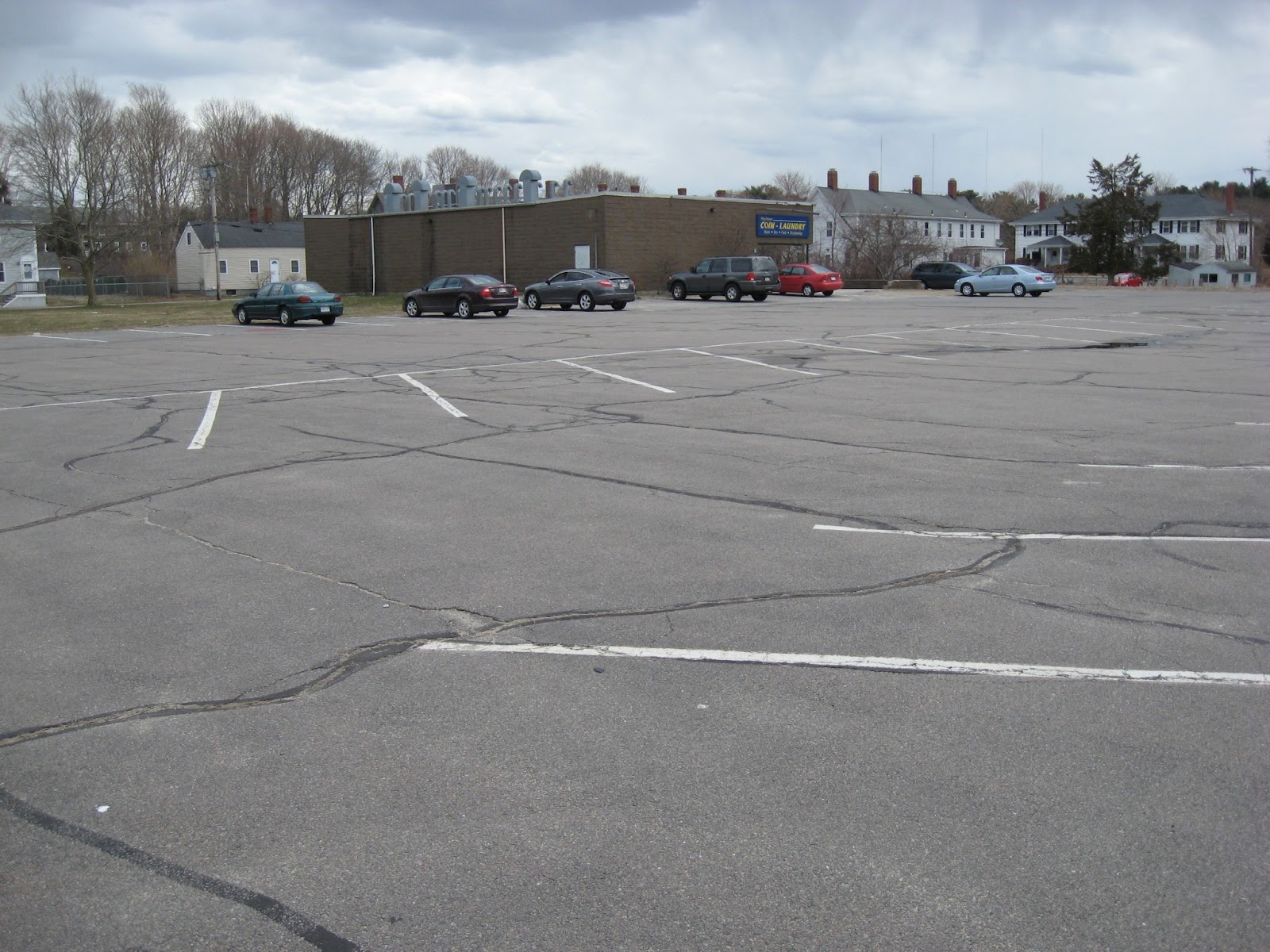
- THE EYESORE. I know that beauty is in the eye of the beholder, but I can’t help but wonder whether anyone actually thinks that this,
is more of an eyesore than this.
Some people don’t like certain
types of buildings, or certain types of architecture. I understand this. But whether
early 19th century construction is your cup of tea or not, I’m
fairly certain that more visitors to Plymouth will stop to appreciate the
Courthouse as it currently stands than if it was razed and paved. People don’t
often spend their vacations taking pictures of parking lots, after all.
- THE POLITICS. The 1820 Courthouse was purchased in 2009 by the Plymouth Town Meeting, which is currently leasing the property to the Plymouth Redevelopment Authority (PRA) for adaptive reuse. The political arena is further complicated by another set of acronyms, the 1820 Courthouse Consortium (1820 CC), which represents a diverse set of interests and is charged with incorporating the building into a reinvigorated waterfront district.
With the number of voices clamoring
to have a say on the issue, it’s no wonder the project is raising so many
hackles, or taking so long. However, all of these voices have come to a
consensus on one thing… the Courthouse ought to stick around. Town Meeting
bought it, the PRA is (re) developing it, and the 1820 CC is working on ways to
integrate it. The question is no longer “should we?” but rather “how should we?”
- THE COST. “The town bought it, and now the people have to pay for it.” Well, yes. Just like a businessman maintains his place of business, or a homeowner his home. It costs a lot of money to stabilize and preserve a historic structure. There are historical and architectural surveys to be undertaken, planners and construction firms to pay. As noted in a report issued by the Urban Land Institute, "given the condition of the existing buildings, the cost to develop the property will be high, for either preservation/adaptive reuse or demolition options.” (Urban Land Institute, p. 14)
But two things make this project
different. First, the Town of Plymouth has
long branded itself as a destination for tourism. Between the months of May and
September, thousands of out-of-state visitors will visit Plymouth attractions,
shop in Plymouth stores, eat in Plymouth restaurants.
They come here to see what makes Plymouth different
from other towns, including old buildings like the 1820 Courthouse. While
certainly necessary for tourism, a parking lot is a convenience to your visit,
not the reason for it.
Second, this statement assumes
that Plymouth residents
will have to shoulder the bill all by themselves. The historic nature of the
structure means that there are Federal and state resources available to help
pick up the slack. Some of the possibilities proposed in the Urban Land
Institute's report include Historic Tax Credits, the Community Preservation
Act, Community Development Block grants, and more. Coupled with the
downtown revitalization project that the Courthouse is supposed to
highlight, the town has the potential to receive a very large return
on a very subsidized investment.
The issues surrounding this building are… complicated, much
more so than this short post may make it seem. And just to be clear, as far as
I know it's not currently in any danger. This was a private citizen I was
speaking to, a citizen with legitimate concerns and no more or less control
over town policy than myself.
But armed with the facts, maybe next time I see him we can
have the discussion that we should have had earlier today.
* *
* * *
Are you a Plymouth resident? Is
there, in fact, another nearby courthouse (previously unknown to me) currently
operating as a meth lab? Did I get all worked up over nothing? If so, please
include info and photos in the space below so we can all disregard the post above.
__________
"1820
Courthouse: Plymouth
landmark boasts venerable history." Wicked Local Plymouth .
March 6, 2013. http://bit.ly/16YDYBg
Urban Land
Institute. "1820 Courthouse Corridor Redevelopment." Plymouth , MA .
Sept. 11, 2012. http://bit.ly/14oOEJC
Subscribe to:
Posts (Atom)